Oriental rug cleaning in Brussels, done the proper way
A hand-knotted rug is a living textile: dyed wool, tight knots, a cotton or silk warp. It is washed with water, flat, with a suitable soap, then dried completely before it comes back to you. That is what Babylone Atelier Tapis does for Brussels and the surrounding area, with the know-how of the Paris house.
Which rugs?
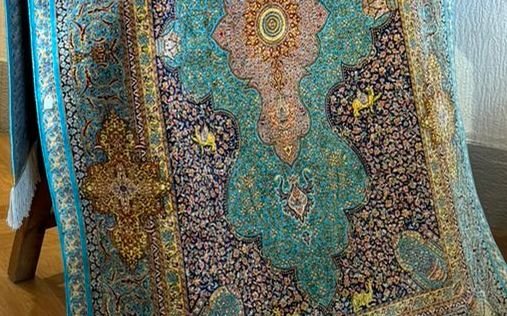
Hand-knotted Persian and Oriental rugs, kilims and flat-woven rugs, wool rugs, silk rugs, antique rugs, good-quality machine-made rugs. Each material has its own soap, its own temperature and its own drying time.
If you don't know where your rug comes from or what it is made of, that's no problem: a photo of the front and a photo of the back are usually enough to tell what it is.
Why a hand-knotted rug is not cleaned like a fitted carpet
Carpet-cleaning companies use spray extraction, on site, with products designed for glued synthetic fibres. On a hand-knotted rug, that method leaves soap in the fibre, wets the warp without drying it, and makes fragile dyes run.
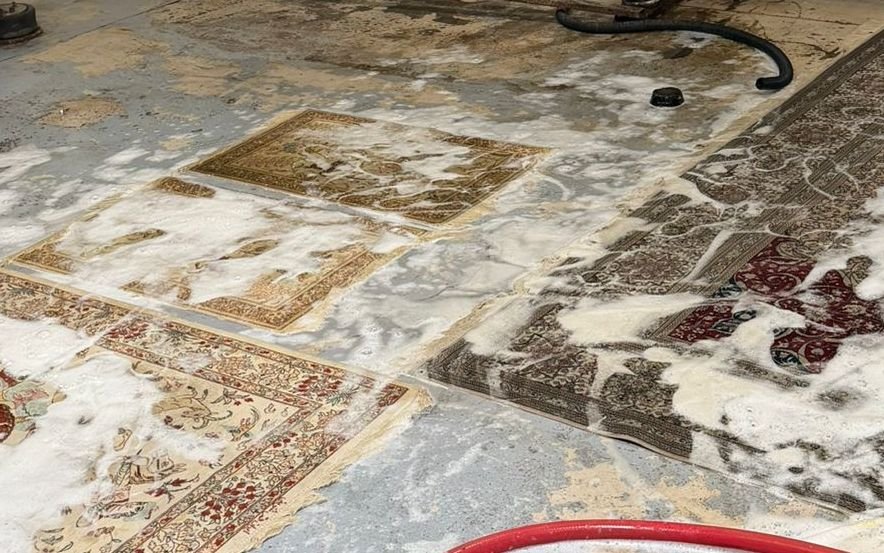
At the workshop, the rug is washed flat, with plenty of water, rinsed until the water runs clear, the water extracted without twisting, then dried right through. The wool regains its lustre, the colours their contrast, and the rug doesn't smell of damp.
Washing, step by step
A hand-knotted rug is not cleaned like a fitted carpet. Here is what we do, filmed in the workshop.
-
01
Brushing and dusting
Before the water, the dust. The whole surface of the rug is brushed to draw out the sand and grit embedded in the pile.
-
02
Washing with water and shampooing
The rug is washed flat, with plenty of water and a soap suited to wool or silk. The foam works the fibres without harming them.
-
03
Rinsing with a jet
A thorough rinse removes the soap and the last of the dirt. Nothing is left in the fibre.
-
04
Extracting the water
The rug goes through rollers and then into a centrifuge: the water is extracted without twisting or distorting the weave.
-
05
Checking and finishing the fringes
Every rug is checked once dry. The fringes are combed and, where needed, repaired by hand.
Stains, odours, pets, water damage
Every rug is examined before washing: wine, coffee or grease stains, pet urine, odours, traces of moths, a rug soaked after a leak or a flood. Some stains come out in the wash, others need localised treatment before or after, and a few never come out completely: we tell you beforehand, not afterwards.
A rug that has got wet by accident needs to be dealt with quickly: the longer it stays damp, the more the warp and the dyes suffer. See our guide to the first hours after water damage.
Collection and return
We arrange collection and return with you when we send the quote, depending on your address and the size of the rug.
You can also drop the rug off at the workshop, at the Schuman roundabout in Brussels, by appointment.
Prices
The price is calculated per square metre and depends on the material, the condition and the treatments needed. It is set by quote, from a photo and the dimensions, before you commit to anything.
Frequently asked questions
Do I need to clear the room or move the furniture?
No: the rug is washed at the workshop, not at your home. It just needs to be accessible so it can be rolled up and taken away.
My rug's colours might run. What do you do?
We test the colour-fastness of the dyes before washing, on a discreet corner. If a colour is unstable, we adapt the wash (colder water, a different soap, less time) or we suggest localised dry-cleaning.
Will the rug shrink or lose its shape?
Washing flat, without twisting, with controlled water extraction and flat drying, keeps the dimensions. That is precisely why we don't use domestic washing machines or wringing.
How often should a rug be washed?
For a living-room rug, a full wash every three to five years is typical; more often with pets or young children. Between washes, a vacuum cleaner without a rotating brush is enough.
Can you clean a very large rug?
Yes, the workshop is equipped for large pieces. Give the dimensions in your request.
Do you clean kilims and flat-woven rugs?
Yes. Kilims are thinner and more sensitive to wetting: they are washed and dried with particular care to avoid any distortion.
How long does cleaning take?
The timing depends on the material, the thickness and the season (drying takes longer in winter). We give you a date with the quote.
Does your rug need a repair too?
Worn fringes, an open selvedge, a small hole: it is best to repair before washing, so the water doesn't make the damage worse.
Request a quote
A photo and the dimensions are enough for a first estimate. We reply by email or by phone.
- 1You send us a photo
A photo of the rug and its approximate dimensions, through the form or by email. No need to come in.
- 2We reply with a clear quote
We look at the material, the condition and any stains, then write back with what we propose and what it will cost. No surprises later.
- 3The rug goes to the workshop and comes back ready to lay
We agree the transport and the timing with you. Your rug comes back clean, dry, fringes combed.